How We Mistook Passivity for Meekness and Left Men Unprepared to Lead
What the Church Got Wrong
The Church got something wrong. Not every church and not every pastor, of course. There are fathers and faithful congregations still forming strong men, and there are pastors willing to tell men the truth even when it costs them attendance. But enough of us got this wrong that we need to admit it. Somewhere along the way, we absorbed the world’s growing suspicion of masculinity. Instead of separating what was sinful in men from what was good, necessary and God-given, we began treating masculine strength itself as something that needed to be softened.
Courage started looking too much like aggression. Leadership sounded suspiciously like control. Competition became unhealthy. Conviction became intolerance. Anger became toxic. Risk became irresponsibility. Confidence became arrogance. Eventually, much of that thinking found its way into the Church. We gave it Christian language, placed it in a Sunday-school classroom, wrapped a few Bible verses around it and occasionally called it spiritual maturity.
To be fair, men gave us plenty of reasons to be cautious. Men have abused strength, misused authority, neglected their families and frightened the people they were supposed to protect. Some men confused leadership with getting their way. Others used Scripture to excuse control, cruelty and selfishness. The Church should confront that directly. Sin does not become respectable simply because a man happens to be strong. But the abuse of masculinity does not make masculinity evil.
Fire can burn down a house, but it can also keep a family warm. The answer is not to eliminate fire. The answer is to contain it, direct it and use it properly. Masculine strength works much the same way. The Church should have been one of the places where boys learned how to become strong, courageous, responsible, truthful, competent and dependable men. It should have taught them to lead without dominating, protect without controlling and confront evil without becoming cruel. It should have shown them how to endure hardship without becoming bitter, exercise authority without making everyone afraid and place all of that strength under the authority of God.
Instead, we sometimes taught men to be suspicious of the very qualities they needed to develop. We did not teach them how to govern strength; we made them ashamed of possessing it. We did not correct masculinity so much as sand off its edges until the approved church man became agreeable, nonthreatening and easy to manage. He learned to apologize before saying anything with conviction. He avoided difficult conversations and called it wisdom. He remained quiet when leadership was required and called his fear of conflict “keeping the peace.”
He was welcome to move tables, park cars, run security, stack chairs and take out the trash, but he was expected to think twice before correcting, confronting or speaking with authority. We confused passivity with patience, indecision with discernment and cowardice with kindness. That is not meekness.
We adopted the world’s suspicion of masculine strength, brought it into the Church and wrapped Scripture around it. We took verses about gentleness and used them to excuse cowardice. We taught men to turn the other cheek before teaching them how to stand on their feet. We praised men for refusing to fight when many of them had never developed the courage, discipline or ability to fight in the first place. Then we called the result Christlike. It was not Christlikeness. We did not sanctify masculine strength. We neutered it.
Powerlessness and meekness can look similar from across the room. Both may appear quiet. Both may avoid conflict. Both may decline to retaliate. But only one of them is a choice. A man who cannot confront evil is not demonstrating meekness by remaining silent. A man who cannot defend anyone is not showing restraint when he does nothing. A man who has never developed courage is not practicing peace when he avoids conflict. He may be harmless, but harmlessness is not holiness. Restraint means something only when action is possible.
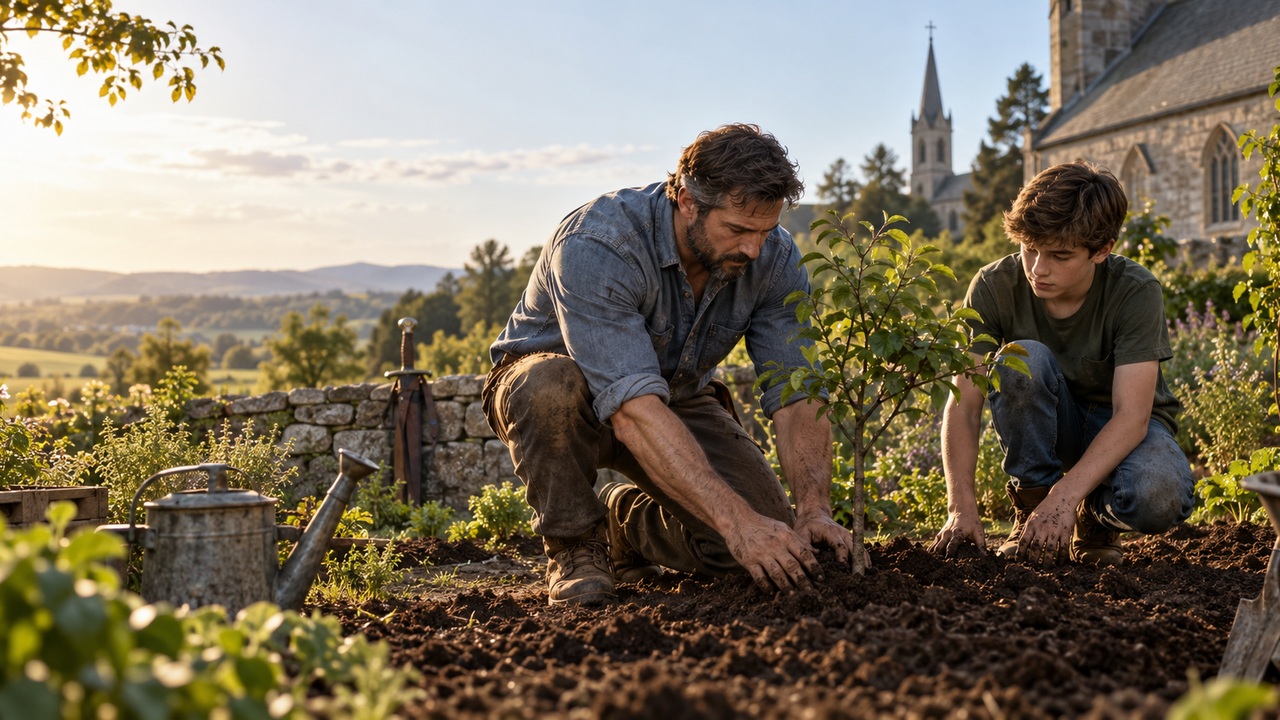
This is why it is better to be a warrior who sometimes gardens than a gardener who suddenly needs to become a warrior. The warrior can kneel in the soil. He can plant, nurture and protect what is growing. He can appreciate beauty, hold his children, comfort the wounded and live peacefully with the people around him. None of those things make him less of a warrior. They reveal that his strength has a purpose beyond himself.
When danger enters the garden, however, he does not have to become someone he has never been. Courage was developed before the crisis. Strength was built before the burden arrived. Discipline was learned before anger awakened. He knows how to stand because he has spent his life preparing to remain standing. The gardener who has never developed the heart of a warrior may value peace, but he may be unable to defend it. When evil arrives, peaceful intentions will not make him courageous, competent or prepared. A crisis does not magically create character. It reveals what was formed before the crisis came.
The point is not that men should become violent or go looking for enemies. A bully is not a warrior. A man who cannot control his temper is not strong; he is ruled by his emotions. A man who possesses strength but uses it to serve his pride, appetites and desires is not meek; he is ruled by his flesh. A boy may be harmless. A tyrant may be dangerous. But it takes a man to be meek.
The meek man possesses the ability to stand, confront, protect and act, yet he submits that ability to the Lord. He does not fight simply because he can, and he does not remain silent simply because he is afraid. When the Lord tells him to stand, he stands. When the Lord tells him to speak, he speaks. When the Lord calls him to defend, he defends. When the Lord requires patience, mercy, forgiveness or calm, he restrains himself and obeys.
That is masculine meekness. It is not the absence of the warrior. It is the warrior surrendered to God. Strength under selfish desire becomes brutality. Strength without discipline becomes destruction. Strength submitted to the Lord becomes meekness. The Church was never supposed to remove the warrior from men. It was supposed to teach the warrior whom he serves.
When good men are trained to be harmless, evil men do not become harmless with them. They simply encounter less resistance. Proverbs 29:2 says, “When the righteous increase, the people rejoice, but when the wicked rule, the people groan.” The character of the men willing to stand affects the condition of everyone around them.
Evil does not require an entire generation of good men to become evil. It only requires enough of them to become passive. The dishonest man benefits when the honest man decides speaking up is too uncomfortable. The bully benefits when the strong man decides confrontation is unkind. The corrupt man benefits when decent men decide leadership is somebody else’s responsibility. Darkness does not always advance because it became stronger. Sometimes the light simply backed away.
Ezekiel tells us that God searched for a man willing to stand in the gap and found none. Isaiah describes truth stumbling, justice disappearing and no one stepping forward to intervene. The tragedy was not merely that evil existed. Evil has always existed. The tragedy was that when the breach opened, no righteous man was standing in it.
That is why the disappearance of strong, godly men matters. A family does not become stronger because a father is afraid to lead. Children do not become more secure because men have forgotten how to carry responsibility. A church does not become healthier because every difficult conversation has been replaced by another meeting about how everyone feels. When righteous men retreat, the space they leave does not remain empty forever. Someone eventually steps into it, and there is no guarantee that man will be good.
What Meekness Really Is
One consequence of all this has been prolonged boyhood. We have physically grown men who still live mostly as consumers. They want comfort without responsibility and respect without having earned trust. They can discuss sports, politics and theology for hours but cannot lead a difficult conversation in their own homes. They want Church to be interesting but not demanding, meaningful but not costly and inspirational but never particularly uncomfortable. We moved them from the youth room into the sanctuary, traded their hot chocolate for designer coffee and assumed growing older had somehow made them men.
Before we ridicule these men, however, we should admit something: many of them were never formed. Some grew up without fathers. Others had fathers who lived in the house but were absent from their lives. Some saw masculinity expressed only through anger, addiction, selfishness or abuse. Others were repeatedly told what not to become but were never shown what a good man actually looked like.
That absence should have made the Church more intentional, not less. The Church has a duty to help form boys into men. It cannot replace a faithful father, but it should stand in the gap when a father is missing, absent or incapable of teaching his son. Older men should have been walking beside younger men, teaching them how to work, pray, lead, sacrifice, control their appetites, respect women, keep their word and recover from failure. Instead, we often gave boys age-appropriate entertainment, moved them into the adult service, handed them a designer coffee and assumed a thirty-minute sermon would finish the job.
The Church failed many of these boys. We preached to them, but we did not disciple them. We told them to be good without teaching them how to become strong enough to choose what is good. We warned them about everything a man should not be but gave them very few living examples of what a godly man could become. Then, when they reached adulthood unprepared, passive and unsure of themselves, we blamed them for being exactly what our neglect helped produce.
That does not remove their personal responsibility. Every man must eventually decide what he will become, regardless of what his father or his church failed to give him. But contempt will not help an unformed man mature. These young men do not need us to mock their weakness from a distance. They need mature men willing to tell them the truth and remain close enough to help them live it.
A boy naturally asks, “What do I want?” A man learns to ask, “What is required of me?” That change does not happen automatically at eighteen, twenty-one, thirty or even fifty. A beard can grow on the face of a boy. A large paycheck can be earned by a coward. A loud voice can hide a frightened man. Biblical manhood has very little to do with trucks, muscles, income, job titles or the ability to intimidate people. It begins when a man recognizes that he is under authority.
His strength, sexuality, ambition, anger, money and decisions do not belong entirely to him. He does not ask God to bless whatever life he has already chosen. He submits that life to God and changes direction when he discovers he is wrong. That submission is not weakness. It is what keeps strength from becoming tyranny.
A godly man accepts responsibility. He cannot spend his life blaming his parents, his wife, his employer, the government, the Church or his circumstances. Eventually, he must take ownership of what God has placed in his hands. He also becomes useful. Good intentions cannot feed a family, repair a home, lead an organization or carry people through a crisis. Competence matters. A man should know how to finish something, solve problems and keep his word. Other people should feel relieved when he walks into a difficult situation rather than nervous about what he might do.
His strength should make the people entrusted to him feel safe. His wife should not fear his temper, and his children should not wonder whether he will show up. The vulnerable should be safer because he is present. Protection is not always physical. Sometimes protecting a family means earning a living. Sometimes it means telling the truth, admitting a mistake, setting a boundary or refusing to disappear when life becomes difficult.
A godly man must also learn to govern himself. He may command employees, run a company, lead a ministry or impress an entire room, but if he cannot govern his appetites, he is not especially powerful. Lust controls him. Anger controls him. Praise controls him. Money, alcohol, pornography, status or resentment may control him. A man who can rule others but cannot rule himself is not a strong man. He is a slave with authority.
The same is true of correction. Boys make excuses; mature men make changes. A man who cannot receive correction is not strong. He is fragile. He does not need to collapse every time someone exposes a weakness, nor does he need to become defensive and explain why every failure was somebody else’s fault. A godly man will fail. He will sin. He will get things wrong. The difference is that he repents, learns, gets back up and continues forward.
None of this prevents a strong man from being tender. A man can love his wife, hold his children, cry, pray, apologize, forgive and show mercy without surrendering a single ounce of masculinity. Those things often reveal how secure his strength really is. An insecure man needs everyone to notice his power. A mature man can use his strength in service to someone besides himself.
Scripture gives us men who make this distinction difficult to ignore. Moses is described as exceptionally meek in Numbers 12:3, yet this is the same man who stood before Pharaoh and demanded the release of an enslaved nation. He confronted one of the most powerful rulers in the world, endured constant criticism and carried the responsibility of leading Israel through the wilderness.
As a younger man, Moses possessed strength without control. He killed an Egyptian and fled. God did not remove his strength during his years in the wilderness; God disciplined it. The impulsive man eventually became the man who could stand before Pharaoh under divine authority. Moses was meek. He was not harmless.
Then there is Jesus. The Church sometimes presents a soft portrait of Christ. He is gentle, speaks quietly, holds a lamb and appears unlikely to disturb anything more serious than a Sunday lunch. Jesus was gentle. He welcomed children, touched lepers, showed compassion to sinners and washed His disciples’ feet. But reducing Him to harmlessness badly misunderstands who He was.
Jesus was not merely a kind teacher offering thoughtful advice about life. Scripture presents Him as the Creator through whom all things were made. John says that nothing came into existence apart from Him. Paul writes that all things were created through Him and for Him and that everything is held together by Him. The hands that washed the disciples’ feet were the hands that formed mankind. The voice that said, “Father, forgive them,” was the voice through which creation came into existence. The man standing before Pilate possessed an authority Pilate could not begin to comprehend.
Jesus calmed storms, cast out demons, healed disease and raised the dead. He confronted religious leaders, drove corruption from the Temple and refused to be intimidated by political or religious authority. When He went to the cross, He did not go because He lacked the power to resist. He went because His power was completely submitted to the will of the Father.
That is meekness. His gentleness was chosen. His patience was chosen. His mercy was chosen. He possessed the authority to judge and willingly carried the cost of our sin Himself. The cross was not a display of helplessness. It was unlimited power under perfect control.
That distinction matters when we talk about anger. Anger is not proof of masculinity. Any toddler can lose his temper. A grown man who frightens his family, punches walls or explodes whenever he feels disrespected is not demonstrating strength. He is proving that his emotions are stronger than he is. But the inability to become angry is not necessarily holiness either. Sometimes it is fear. Sometimes it is indifference.
A man should feel something when children are harmed, truth is corrupted, families are destroyed, the vulnerable are exploited or sacred things are treated with contempt. The question is not simply whether a man becomes angry. The question is whether his anger answers to God. The meek man learns to ask himself uncomfortable questions: Am I confronting injustice, or am I defending my pride? Am I trying to correct what is wrong, or am I looking for permission to release my anger? Am I protecting someone, or am I trying to prove that I am in charge?
He learns to confront without becoming cruel, exercise authority without worshipping it and forgive without pretending nothing happened. He becomes slow to take personal offense and quick to defend someone entrusted to his care. Masculine strength was never given so men could admire themselves. It exists to build, protect, provide, endure, lead, confront evil, defend the vulnerable and carry responsibility. The measure of a godly man is not how much power he can display. It is how much weight he can faithfully carry.
Men Must Form Men
I am 58 years old, and I can count on one hand the men who deliberately walked beside me and helped form me. I have heard hundreds of sermons. I have attended more church services than I could begin to remember. I have listened to gifted speakers explain leadership, marriage, faith and responsibility. But preaching to a man is not the same as discipling him. Information can be delivered from a stage. Formation requires someone to stay.
Sitting in rows and facing a platform is not brotherhood. Men need other men who know them well enough to ask uncomfortable questions and who care enough to wait for honest answers. Are you keeping your word? Are you leading your family? Are you controlling your appetites? Are you telling the truth? Are you doing the work? Are you becoming the man you keep telling everyone you intend to become? Iron sharpens iron through friction, not constant affirmation.
If we believe men have become passive, detached, immature or unprepared to lead, we will not solve it with another men’s breakfast where we eat powdered eggs, discuss football and hear a speaker remind us to be nicer to our wives. There is nothing wrong with breakfast, football or being nicer to our wives. But formation requires more than a monthly event and a folding chair.
Mature men must come forward. We cannot complain about weak young men while refusing to help make them strong. We cannot criticize fatherless boys while remaining too busy to walk beside them. We cannot blame churches for failing to form men while experienced men wait for a program, title or invitation before becoming involved in another man’s life.
Find a younger man who needs somebody. Find the boy who was never taught how to work, pray, control his anger, honor women, keep his word or recover from failure. Find the young husband who does not know how to lead his home. Find the new father who is quietly terrified that he will repeat every mistake his own father made. Then do something remarkably difficult in our age of programs, podcasts and platforms: stay.
Let him work beside you. Let him watch how you treat your wife, handle money, admit mistakes, endure pressure, read Scripture and make difficult decisions. Teach him something useful. Correct him when he is wrong. Encourage him when he wants to quit. Tell him the truth when accepting his excuse would be easier. Do not treat him like a project. Love him like a son or a brother.
Be patient with what he does not know. Remember how long it took you to learn what now seems obvious. Do not use his weakness to make yourself feel strong. Help him develop strength of his own. Show him that a man can admit failure without deciding he is a failure. Show him that repentance is not humiliation and correction is not rejection. Let him see you apologize when you are wrong. Let him discover that mature masculinity does not require pretending to be invincible.
Walk beside him until he can walk on his own, and then teach him to do the same for somebody else. That pattern is hardly new. Moses prepared Joshua. Elijah walked with Elisha. Paul treated Timothy as a son in the faith. Jesus did not lecture the Twelve once a week and hope they took good notes. He lived with them, corrected them, gave them responsibility, allowed them to fail and prepared them to continue the work after He was gone.
Men need more than information. They need formation. They need to see what courage looks like when life becomes painful. They need to watch a mature man control his anger, keep his word, protect his family, repent when he is wrong and remain faithful when obedience costs him something.
We should not produce arrogant, violent or domineering men. A loud bully is not a biblical man, and swagger is often insecurity wearing work boots. But neither should we continue producing passive men who disappear whenever courage becomes expensive.
The Church needs men who can bear weight, tell the truth when lying would be easier, protect without controlling, lead without dominating and serve without needing applause. It needs men who can receive correction without collapsing and confront wrongdoing without hatred. It needs warriors who know how to tend a garden—men capable of strength without worshipping it, tenderness without weakness, peace without cowardice and anger without sin.
We need men who are patient with the immature, compassionate toward the wounded, safe for their families, dangerous to evil and completely submitted to God. The Church did not ask too much of men. It asked far too little.
God is not calling men to become harmless. He is calling them to become holy and strong enough to do good, disciplined enough to refuse evil and meek enough to obey Him.
About the author: Brian Wheeler is an entrepreneur, business executive, corporate board director and founding board member of The Dallas Express. With more than 30 years of experience in business, marketing, advertising and commercial printing, he has served on the boards of both public and private companies. His writing explores faith, culture, leadership, character and personal responsibility.
The views expressed in this opinion column are those of the author and do not necessarily reflect the views of The Dallas Express.
Provided by Dallas Express