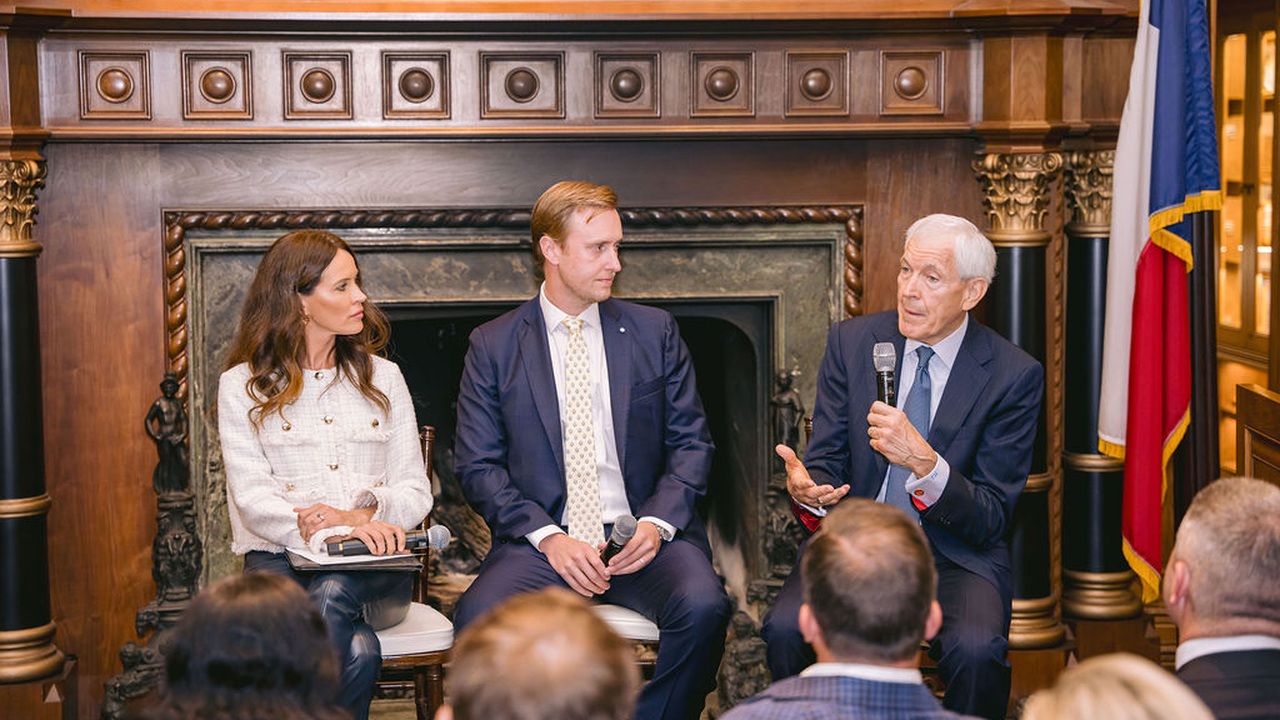
MCBA Leadership Forum featured former Dallas Mayor Tom Leppert, Will McNutt and guest moderator Amy Robbins
Dallas has no shortage of impressive places to hold a business meeting, but Old Parkland is in a category of its own. Walking through the historic campus is a refreshing change from the glass, steel and contemporary architecture that dominate much of the city. The rich woodwork, classical design, artwork and remarkable attention to detail take visitors back to an era when buildings were designed to be admired, not simply occupied. Even a small room displaying memorabilia associated with President Abraham Lincoln gives guests a reason to slow down and appreciate their surroundings.
On Monday evening, October 12, the Metroplex Civic & Business Association (MCBA) welcomed business executives, civic leaders and public officeholders to Old Parkland’s historic Pecan Room for a conversation about leadership and public service. Former Dallas Mayor Tom Leppert and Dallas businessman Will McNutt sat before one of the room’s large fireplaces for a discussion moderated by entrepreneur and media correspondent Amy Robbins. The fireplace and beautiful old-world craftsmanship gave the gathering the comfortable atmosphere of a conversation among friends rather than a formal business presentation.
The setting alone was worth the visit, but the discussion proved even better. Having attended more than a few business and leadership events over the years, I found this to be one of the most thoughtful and engaging conversations I’ve experienced in quite some time. Rather than relying on familiar leadership slogans, both speakers drew from their experiences in business and government to address questions about developing future leaders and improving the institutions they serve.
Bringing individuals like Leppert and McNutt together with Dallas business leaders is precisely why MCBA exists. The Metroplex Civic & Business Association is a nonpartisan, nonprofit business league dedicated to bringing business leaders, thought leaders and public officeholders together to discuss leadership and the future of Dallas. Through its Leadership Forums, MCBA creates opportunities for business executives and elected officials to exchange ideas and better understand the challenges facing the region. The organization also encourages civic participation through its VOTElocal and GIVElocal programs, helping member companies engage their employees in local, nonpartisan elections and volunteer with charities throughout the Metroplex.
MCBA CEO Julie Strum put more detail behind that work when she highlighted VOTElocal, the association’s program designed to help member companies encourage their employees to register, make informed decisions and participate in elections. She explained how businesses can make civic participation easier by providing employees with timely information and reminders. Her message was especially relevant with early voting in person for the November 3 general election beginning this coming Monday, October 19. MCBA reports that turnout among employees reached through VOTElocal reminders and recommendations is four times that of the general population, demonstrating the difference employers can make when they encourage their teams to vote.
Dallas City Council member Bill Roth was among the public officials in attendance. His presence alongside members of the business community reflected MCBA’s commitment to encouraging constructive relationships between those responsible for governing Dallas and those helping drive its economy.
The Leadership Forum was presented by Ben Abbott and Associates, with Dallas attorney and civic leader Ben Abbott introducing the evening’s featured guests and moderator. Abbott has practiced law in Dallas since 1987, building a legal career spanning nearly four decades. His firm has tried more than 1,300 jury cases, but Abbott’s contributions to the community extend beyond the courtroom. He has been involved with numerous civic organizations, including Downtown Dallas, Inc., the Greater Dallas Planning Council and the World Affairs Council. His support of the forum reflected a continuing commitment to strengthening Dallas through business and civic involvement.
Serving as guest host and moderator was Amy Robbins, founder of Alexo Athletica, media personality and member of MCBA’s Leadership Council. Robbins built her company around an innovative approach to women’s athletic apparel, combining contemporary activewear with discreet personal-protection features. Her entrepreneurial success has attracted national media attention, and she has developed a career in broadcasting, public speaking and commentary. Robbins brought that experience to the discussion, guiding the speakers through questions about leadership, personal development and the responsibilities that come with public service.
Much of the evening centered on the White House Fellows program, established by President Lyndon B. Johnson in 1964. The program selects a small group of accomplished Americans each year to spend approximately twelve months working alongside senior federal government officials. Fellows gain firsthand experience with national policymaking, government operations and executive leadership before returning to their careers and communities. The objective is to develop individuals who will use their professional experience and understanding of public service to make a broader contribution to the country.
Leppert brought a particularly interesting perspective to the subject. In 1984, early in his business career, he was selected as one of only 13 White House Fellows from more than 1,200 applicants nationwide. He served during President Ronald Reagan’s administration, gaining experience at the highest levels of the federal government. That opportunity became part of a career that would eventually include leading major corporations and serving as mayor of Dallas from 2007 to 2011. Leppert later served on the President’s Commission on White House Fellowships, helping identify future generations of leaders.
McNutt, a Dallas native and co-founder and president of Anthem Development, brought another perspective. His professional background spans real estate development, law and military service, including more than a decade serving as an attorney for the Texas Military Department. As a member of the President’s Commission on White House Fellowships, McNutt is involved in evaluating individuals seeking the opportunity to serve at the highest levels of government. Together, the two men offered an interesting look at the fellowship from the experience of someone who participated in the program and those who have helped select future participants.
One of the evening’s most memorable moments came when McNutt made a direct request of the business owners and executives in attendance. He encouraged them to look within their own organizations, identify their most talented and promising employees, and recommend that those individuals apply for the White House Fellows program. If selected, McNutt asked employers to support those employees by making it possible for them to step away from their regular responsibilities for a year of public service.
It was a practical request, but not necessarily an easy one. Most business owners spend considerable time and resources recruiting talented people, developing their abilities and building organizations around their contributions. Encouraging one of your best employees to leave for an entire year, even for an exceptional opportunity, requires looking beyond the immediate needs of the business. But that was precisely the point of McNutt’s challenge. Developing future leaders sometimes means providing opportunities that extend well beyond the company where their careers began.
Somewhere within our organizations may be the next great civic leader, public servant or even future mayor of Dallas. But identifying that individual is only the beginning. Are we willing to encourage their development, open doors for them and even allow one of our most valuable employees to leave for a year of public service? McNutt reminded us that investing in people sometimes means making decisions that benefit more than our own businesses. It was a challenge that gave everyone in the room something specific to consider when they returned to their companies.
Leppert also addressed an issue much closer to home: the structure of Dallas city government and his belief that the city would benefit from a stronger mayoral system. Dallas currently operates under a council-manager form of government, where the elected mayor serves alongside the City Council while a professional city manager oversees much of the city’s daily administration. Although the mayor is elected by voters throughout Dallas, the position does not carry the same executive authority found in cities operating under a strong-mayor system.
Leppert shared his vision for changing that structure, giving the mayor greater authority and more direct responsibility for the operation and direction of city government. His perspective comes from having served on both sides of the leadership equation. Before becoming mayor, Leppert held senior executive positions with major corporations, including serving as chairman and CEO of Turner Corporation. His experience leading large business organizations gave him a firsthand understanding of executive responsibility, while his four years as Dallas mayor provided direct experience with the city’s council-manager system.
His proposal raises an important question about how Dallas should be governed as the city continues to grow and confront increasingly complex challenges. Supporters of a stronger mayoral system believe it could improve accountability by giving voters a clearer understanding of who is responsible for the city’s performance. Others believe the current structure provides an important balance of authority between elected representatives and professional city management. Regardless of where one stands on the issue, understanding how Dallas government works and considering whether changes might improve its effectiveness is a worthwhile conversation for the business community.
Leppert’s message was about more than changing a government organizational chart. It raised questions about responsibility, authority and the ability of elected officials to deliver results. Whether we agree with his proposal or not, those of us who build businesses, employ people and raise families in Dallas have a considerable interest in how our city is governed. His discussion was a reminder that business leaders have an opportunity to become better informed about local government and participate in conversations that will help determine the city’s future.
That is also why MCBA’s nonpartisan approach matters. The organization’s purpose is not to tell members what position to take on a particular issue, but to provide opportunities for business leaders and public officials to engage directly with the challenges affecting Dallas. Not every discussion will produce agreement, nor should it. Bringing experienced people together to examine difficult questions is a worthwhile beginning.
What struck me most about the evening was that neither speaker suggested everyone in the room needed to run for public office or become involved in politics. McNutt asked us to recognize and develop the leadership potential already within our organizations. Leppert encouraged us to take a greater interest in the government responsible for the community around us. Both were practical reminders that civic responsibility doesn’t belong exclusively to elected officials. Business leaders have opportunities every day to contribute their experience, resources and influence to something larger than their own companies.
About the author: Brian Wheeler is an entrepreneur, business executive, corporate board director and founding board member of The Dallas Express. With more than 30 years of experience in business, marketing, advertising and commercial printing, he has served on the boards of both public and private companies. His writing explores faith, culture, leadership, character and personal responsibility.
The views expressed in this opinion column are those of the author and do not necessarily reflect the views of The Dallas Express.
Provided by Dallas Express