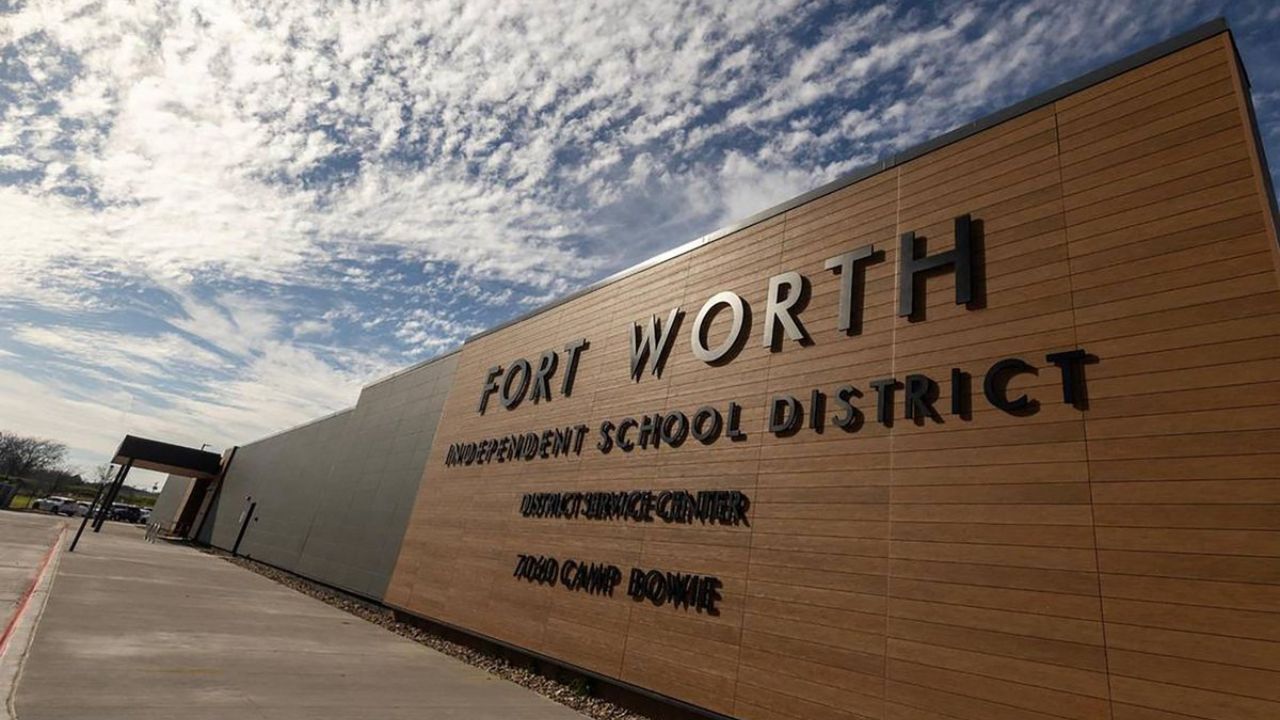
Fort Worth ISD is shifting language services for students learning English after closing International Newcomer Academy in June, a move that comes as language-support students now make up about 42% of district enrollment.
The state-run district’s new model moves support for newcomer and emergent bilingual students away from a centralized academy and closer to neighborhood and comprehensive campuses.
District leaders say students will learn English while taking grade-level courses in reading, math, science, social studies, and other subjects alongside the broader student population.
The change comes under Superintendent Peter Licata as Fort Worth ISD continues restructuring under state-appointed leadership.
English-Learner Population Grows
Fort Worth ISD had 29,555 emergent bilingual and English learner students during the 2024-25 school year, representing about 42% of the district’s enrollment, according to district data reported by the Fort Worth Report. That figure was up from about 34% five years earlier.
The district also reported enrolling 5,401 immigrant students in 2025, compared with 2,455 in 2020, according to the report. The federal “immigrant student” category refers to students ages 3-21 who were not born in a U.S. state and have not attended U.S. schools for more than three full academic years. The category does not describe a student’s legal immigration status.
At the same time, Fort Worth ISD reported employing 787 bilingual or English-as-a-second-language teachers in 2025, down from 870 in 2020, according to the report.
Families reported a range of home languages in district survey data, including English, Spanish, Swahili, Dari, Pashto/Pushto, Kinyarwanda, Farsi/Persian, Arabic, Burmese, and French.
Parents Question Transition
The transition has raised concerns among some parents whose children attended International Newcomer Academy.
Liz Orozco, whose 14-year-old son Andrew Garcia has been in the United States for about six months, told the Fort Worth Report that her son began reading and understanding more English at the academy but still struggles to speak English in class and follow a teacher’s directions.
Orozco said she expects Andrew to attend Dunbar High School next school year after the academy’s closure.
“If my son goes to the regular high school, it will be so hard for him,” Orozco said in Spanish, according to the Fort Worth Report. “How will he understand a teacher?”
“This is a new country for us,” Orozco said. “This is new people, new culture and the language.”
District Defends New Model
Fort Worth ISD said in redesign materials that students will receive structured conversations, clear language objectives, collaborative learning with peers, multilingual materials, lessons created by bilingual professionals and English-as-a-second-language experts, and ongoing coaching for teachers, according to the Fort Worth Report.
“We are not removing support; we are delivering it directly where students are receiving content instruction,” the district said in the materials.
Licata said during an April board meeting that the redesign gives students access to grade-level classrooms, electives, fine arts, athletics, extracurricular activities, and college and career readiness pathways while building language support into instruction, according to the report.
District leaders also said the majority of Fort Worth ISD newcomer students already attend comprehensive middle and high school campuses rather than International Newcomer Academy.
Experts Warn Execution Matters
Education researchers told the Fort Worth Report that a campus-based model can work if schools have trained teachers, clear plans, and wraparound support.
“It’s not that the district couldn’t make really strong newcomer supports at the school level,” University of Oregon professor Ilana Umansky told the Fort Worth Report. “But if they had really strong newcomer supports in the academy model and they’re closing that down without a plan for making sure that they’re going to have those supports at the school-site level, then that would raise some red flags for me.”
Elizet Kneisler, a University of Texas at Austin professor whose work focuses on bilingual education and dual language programming, also questioned whether the district can prepare campuses quickly enough.
“You don’t create a transition plan just in the summer,” Kneisler told the Fort Worth Report.
State Takeover Reshapes District
The language-services change comes as Fort Worth ISD continues a broader restructuring.
As previously reported by The Dallas Express, the Texas Education Agency replaced Fort Worth ISD’s elected board with a state-appointed board of managers and named Licata superintendent in 2026 following years of academic underperformance.
The district has also named new leaders at more than 30 campuses and approved the closure of 18 campuses.
The Dallas Express reached out to Fort Worth ISD for additional comment regarding the language-services transition but did not receive a response before publication.
Provided by Dallas Express