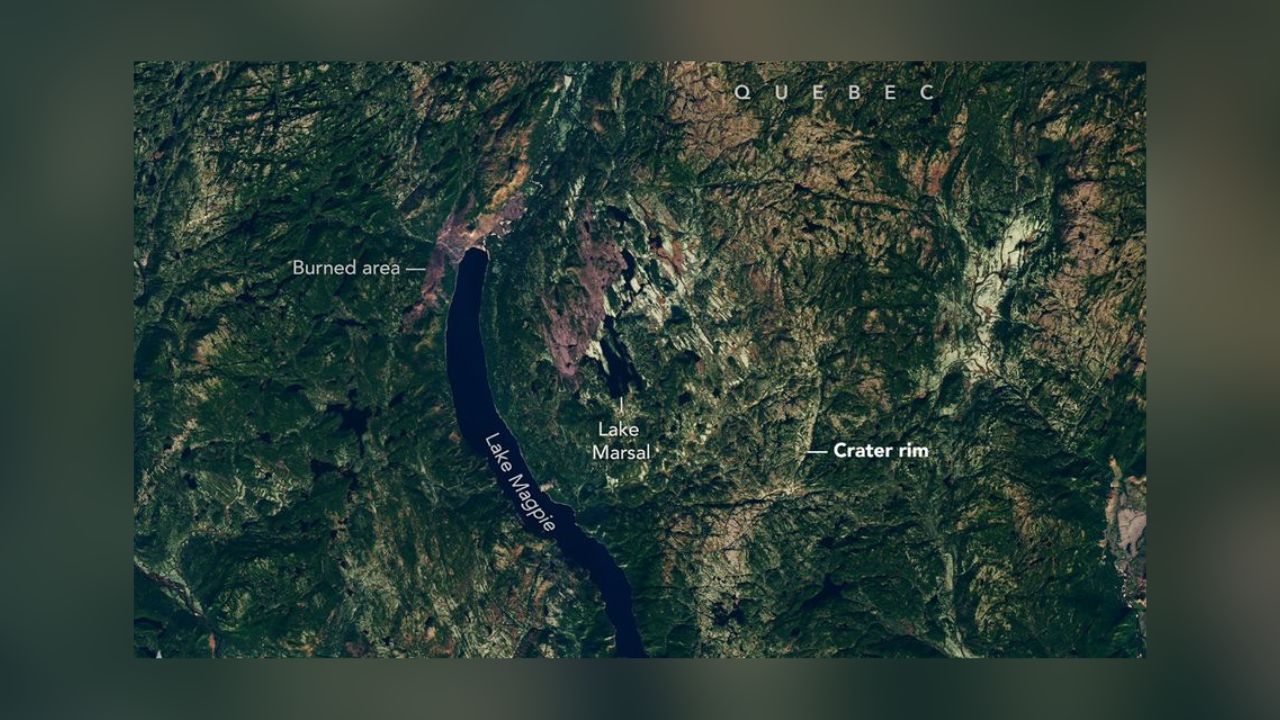
An amateur astronomer searching satellite maps for a potential campsite in Quebec instead helped scientists identify a massive impact crater believed to have formed about 390 million years ago.
The circular feature near Lake Marsal in Quebec’s remote Côte-Nord region spans about 25 kilometers, or 16 miles. Researchers have named the structure Uhackatik after consulting with the Innu Council of Ekuanitshit.
NASA Earth Observatory featured the discovery as its September 15, 2026, Image of the Day, highlighting how an observation made during trip planning led to a major geological investigation.
A Strange Circle on a Satellite Map
Joël Lapointe noticed the unusual circular feature in 2024 while using online satellite imagery to scout campsites. Suspecting it could be an impact crater, he contacted researchers in Europe and North America.
His inquiry led French researchers to identify the Lake Marsal area as the center of a possible impact structure at a 2024 Meteoritical Society meeting. The discovery eventually reached Gordon Osinski, a planetary geologist at Western University and director of the Impact Earth database.
Osinski was initially skeptical because circular geological formations can have several explanations. Previous geological mapping had interpreted breccia in the area as part of a volcanic structure known as a diatreme.
He organized an expedition to investigate the site in October 2025.
Shatter Cones Confirm Impact Evidence
Reaching the site proved difficult. Researchers arrived by floatplane, but the aircraft could not reach the shoreline. The team had to wade about 50 meters, or 165 feet, through the lake while carrying equipment.
The terrain beyond the shore was rugged, swampy, and densely vegetated.
By the second day, however, researchers had found distinctive shatter cones in multiple rock outcrops. The cone-shaped fractures form under the extreme pressures generated by meteorite impacts.
“It’s the only unequivocal evidence of an impact event that you can see in the field with the naked eye,” Osinski said, per NASA.
The discovery shifted the interpretation from a volcanic formation to a large complex impact crater.
Researchers identified a central uplift, where rock rebounded following the impact, along with cliffs displaying columnar jointing. Together, those features provide strong evidence of a major ancient impact.
Ancient Crater Spans 25 Kilometers
Rock samples indicate the impact occurred roughly 390 million years ago, during the Devonian Period.
NASA said Earth has about 200 confirmed impact structures, while geologists believe hundreds more remain undiscovered. Erosion, tectonic activity, vegetation and remote locations can make ancient craters difficult to identify.
At approximately 25 kilometers across, Uhackatik would be the largest impact crater discovered since the 31-kilometer Hiawatha structure beneath Greenland was identified in 2018.
Osinski said an impact of similar size occurring in Quebec today would cause regional devastation and potentially have global climate effects.
The site is also roughly 100 million years older than a period of increased impact activity that some researchers have linked to collisions in the asteroid belt.
Formal Recognition Is Still Pending
Although researchers consider the impact origin essentially established, formal recognition by the Meteoritical Society’s Impact Cratering Committee is still pending.
The discovery also demonstrates how satellite imagery can help identify geological features in remote areas. Osinski is a member of NASA’s Artemis Geology Team and helps train astronauts, but he said Uhackatik is too difficult to access to serve as a practical training site. A younger impact structure at Labrador’s Mistastin Lake is more accessible for that purpose.
For Lapointe, the discovery began with simply noticing an unusual pattern on a map.
He later told CityNews he was “over the Moon” when researchers confirmed the feature was an impact crater.
“I encourage everyone to not ignore intuition or an observation, even if it isn’t part of your field of expertise,” Lapointe said, per Radio Canada. “It could be a discovery!”
Provided by Dallas Express